
- By adminbackup
- In
Rabby Wallet herunterladen: How the Chrome Extension Changes the DeFi Risk Model
What if the most important feature of a crypto wallet were not the ability to send tokens, but the ability to show you what a transaction is likely to do before you sign it? That question explains why Rabby Wallet has attracted attention among Ethereum and other EVM users, including those in Germany who move between several networks rather than remaining on one chain. The usual search terms—“Rabby Wallet herunterladen,” “Rabby Wallet,” or “Rabby Chrome extension”—sound like a simple installation task. In practice, the more important decision is architectural: do you want a wallet that mainly presents signing requests, or one that actively interprets the proposed state change?
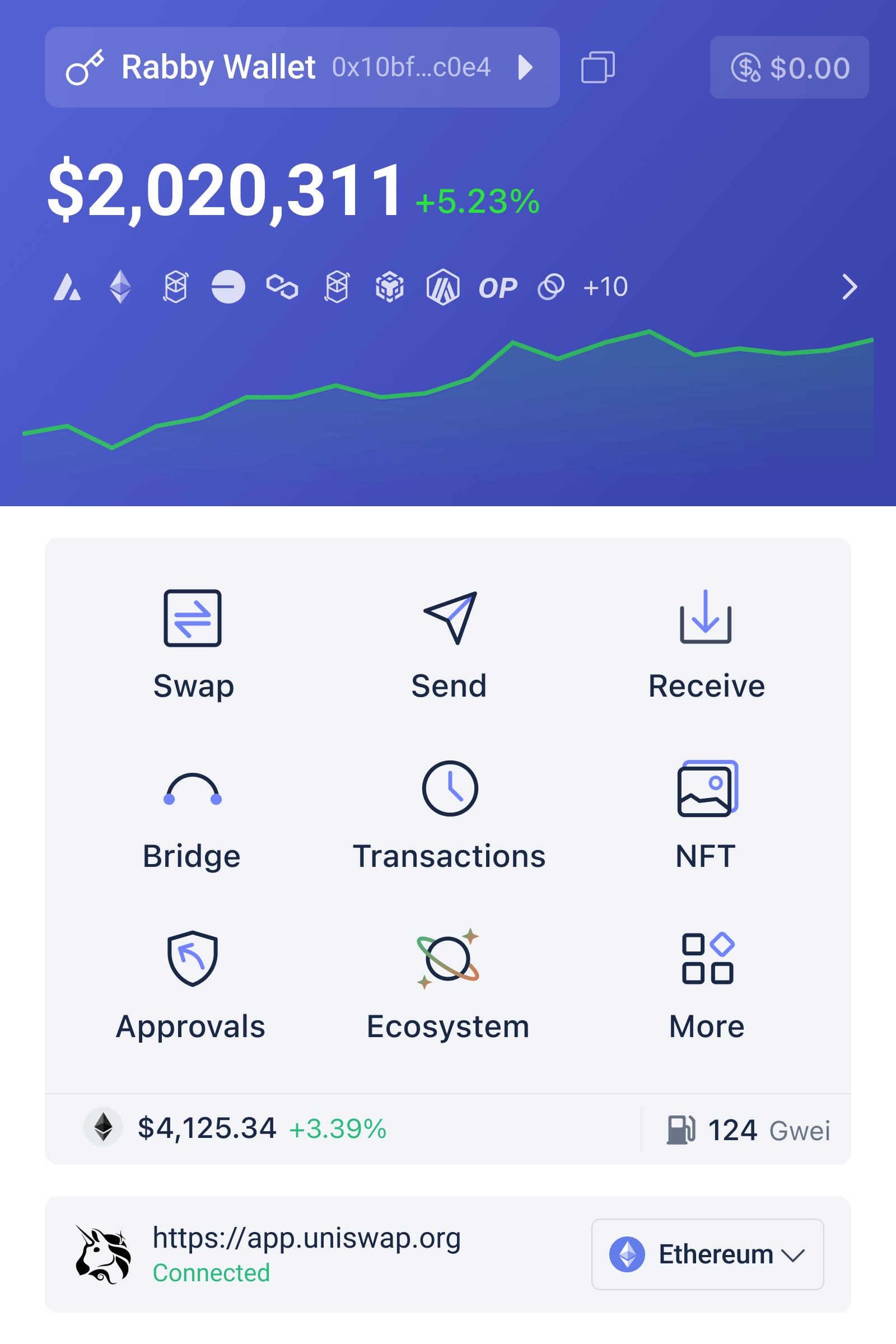
Rabby is a non-custodial wallet developed by DeBank and designed for decentralised finance. It supports more than 140 EVM-compatible networks, including Ethereum, Polygon, Arbitrum, Optimism, Avalanche, Base, and BNB Chain. Its attraction is therefore not just breadth. It combines automatic network switching, transaction simulation, contract warnings, swaps, bridging, and hardware-wallet support in one interface. These features can reduce operational friction, but they do not remove the underlying risks of smart contracts, malicious websites, faulty simulations, or poor key management. A better mental model is that Rabby can improve the quality of a user’s inspection process; it cannot make permissionless finance risk-free.
Rabby versus MetaMask: Similar Role, Different Emphasis
Rabby is often described as an alternative to MetaMask, and at the basic level the comparison is fair. Both can act as browser wallets for EVM applications, allow users to connect to decentralised applications, and support transaction signing. The meaningful distinction lies in the workflow. MetaMask has traditionally been widely used as a general-purpose gateway to Web3, while Rabby places stronger emphasis on multi-chain DeFi navigation and pre-signing risk information.
For a user who works mainly on Ethereum, the difference may be modest. For someone moving between Ethereum mainnet, Layer 2 networks, sidechains, and application-specific environments, manual network selection can become a source of avoidable mistakes. Rabby’s automatic network switching is intended to match the wallet to the chain requested by a connected dApp. This is convenient, particularly when a German user is comparing lending markets or decentralised exchanges across several networks. Yet convenience has a boundary: automatic switching tells the wallet where the application wants to operate, not whether that application deserves trust.
This distinction matters because usability and security can pull in opposite directions. Fewer manual steps reduce configuration errors, but they can also make network changes less visible to a hurried user. A prudent workflow still includes checking the chain, the website domain, the asset involved, and the final recipient or contract. Automation should remove repetitive work, not replace attention.
Why Transaction Simulation Is More Than a Visual Feature
A transaction is not merely a payment. In DeFi, it may call a smart contract, approve a token allowance, exchange one asset for another, deposit collateral, borrow funds, or interact with a bridge. The wallet’s transaction simulation attempts to preview the expected changes to token balances before the user signs. This converts an opaque technical request into a more practical question: what assets should leave my wallet, what should arrive, and what permissions may remain afterward?
That is a significant conceptual improvement. Many users treat the wallet confirmation window as if it were an invoice. In reality, a smart-contract call is closer to authorising a program to modify an account’s state according to specified rules. Simulation provides an estimate of the resulting state, helping the user identify an unexpected token transfer, an unusually large approval, or a result that differs from the intended trade.
However, simulation is not proof of safety. It depends on the relevant chain state, the quality of the simulation environment, and the behaviour of the contract under the conditions being tested. A malicious or complex contract may behave differently when the transaction is actually mined. Market prices can move, liquidity can change, and bridge or oracle dependencies can introduce risks that are not fully captured by a balance preview. A warning-free result should therefore be interpreted as “no detected problem under the tested conditions,” not “this protocol is safe.”
Rabby’s integrated security engine adds another layer by checking contracts and addresses for signals associated with phishing, known exploits, or unlimited token approvals. These warnings are useful as risk indicators. They are not a substitute for verifying the dApp through an independent source or understanding what an approval permits. The practical rule is simple: use the scanner to slow down questionable actions, and use your own verification process to decide whether the action is appropriate.
What “Non-Custodial” Actually Protects—and What It Does Not
Rabby stores private keys locally on the user’s device rather than transmitting them to Rabby’s servers. This non-custodial structure means the company does not hold the keys needed to sign transactions on the user’s behalf. The core signing functions can remain available even if Rabby’s backend services are unavailable, because the wallet itself does not need to surrender control of the keys to a central operator.
That independence is valuable, but it is frequently misunderstood. Non-custodial does not mean non-technical or automatically secure. The user remains responsible for the recovery phrase, device security, browser hygiene, and protection against phishing. A compromised computer can expose a wallet even when the software architecture is sound. Losing the recovery phrase can also mean losing access permanently. In other words, custody risk is reduced, not eliminated; it is transferred from an exchange or service provider to the individual.
Open-source software, released under the MIT licence, improves the possibility of independent code review and community scrutiny. It does not guarantee that every deployment, dependency, browser environment, or future update is harmless. Security is a system property, not a label attached to a single code repository. Users handling meaningful funds should consider connecting Rabby to a hardware wallet such as Ledger, Trezor, or OneKey. This separates the private-key operation from the everyday browser environment, although even hardware wallets cannot prevent a user from approving a deceptive transaction.
Multi-Chain Convenience: Bridges, Swaps, and Gas
Rabby’s integrated tools address a common practical problem in DeFi: assets and applications are distributed across networks, while transaction fees are paid in each network’s native token. The wallet can integrate bridge routes such as LI.FI, and its swap function can compare liquidity from decentralised exchanges including Uniswap and 1inch. The intended benefit is less tab-switching and a clearer route from one asset or chain to another.
The trade-off is that aggregation concentrates several moving parts inside one interface. A bridge transaction carries smart-contract, liquidity, counterparty, and settlement risks in addition to ordinary wallet risk. A swap aggregator may identify an attractive quoted route, but the final outcome still depends on slippage, liquidity, fees, price movement, and the contracts used along the path. “Best rate” is therefore conditional, not absolute. It may mean the best available quote at that moment under the selected route and assumptions.
The Gas Account feature is similarly convenient because it allows network fees to be paid with stablecoins such as USDC, even when the user lacks the chain’s native token. For newcomers, this removes one of the most frustrating barriers to using a new network. Yet it also hides a useful operational lesson: every transaction still has a cost, even when the wallet abstracts the native gas asset. Users should understand the conversion, service conditions, and network dependency rather than treating stablecoin gas as free execution.
How to Approach a Rabby Wallet Download in Germany
For users searching for a Rabby Wallet download or the Rabby Chrome extension, source verification should come before installation. The browser extension is primarily available for Chrome, Brave, and Edge, with desktop versions for Windows and macOS and mobile applications for iOS and Android. Use the project’s recognised distribution channels and inspect the publisher carefully. Search advertisements, cloned websites, and fake wallet extensions are common attack surfaces because the recovery phrase is valuable at the moment of setup.
After installation, create or import a wallet only in an environment you control. Never enter a recovery phrase into a website, form, support chat, or unofficial “verification” page. Keep a separate account for experimentation and avoid granting broad approvals to unfamiliar contracts. If a warning appears, do not dismiss it merely because the transaction involves a familiar token. For an additional orientation point before starting, readers can find the relevant installation information here.
Rabby Points, earned through activities such as swaps, gas top-ups, or referrals, may add a loyalty or gamified element. That feature should not influence security decisions. Incentives can encourage activity, while safe custody often requires restraint. The fact that a transaction earns points says nothing about whether its economic outcome or contract permissions are favourable.
Recent project messaging has presented Rabby as a wallet for Ethereum and EVM networks, emphasising simplicity, speed, security, and broad on-chain use. The useful interpretation is not that these qualities have been proven universally, but that the product is competing on workflow design: more chains, more contextual warnings, and fewer manual steps. The next signals worth watching are practical ones—how transparent simulations remain as DeFi contracts become more complex, how users understand bridge routes and fee abstraction, and whether security warnings meaningfully change behaviour rather than becoming background interface noise.
FAQ
Is Rabby Wallet safer than MetaMask?
It may provide a more informative security workflow for multi-chain DeFi through transaction simulation, contract warnings, and automatic network handling. That does not make it categorically safer in every situation. The user, the dApp, the device, and the signing decision remain decisive. Rabby is best understood as a strong inspection-oriented alternative, not as an insurance policy against scams or smart-contract failure.
Can Rabby be used without a hardware wallet?
Yes. Rabby can operate as a software wallet with keys stored locally on the device. For small experimental balances, that may be practical. For substantial holdings, hardware-wallet compatibility with devices such as Ledger, Trezor, or OneKey can reduce exposure to browser and computer compromises. It still does not remove the need to verify what is being signed.
Does transaction simulation guarantee that a DeFi transaction is safe?
No. Simulation previews expected state changes and can reveal suspicious transfers or approvals, but it is conditional on the tested environment and available data. Contract logic, changing market conditions, bridge dependencies, and malicious behaviour can create risks beyond the preview. Treat the simulation as an informed checkpoint, not a guarantee.
The central choice is therefore not simply whether to download Rabby Wallet. It is whether the wallet’s model of warnings, simulations, and multi-chain automation fits the way you manage risk. For active EVM users, that model can make complex actions easier to inspect. Its real value appears when convenience leads to better questions before signing—not when it encourages the user to stop asking them.
